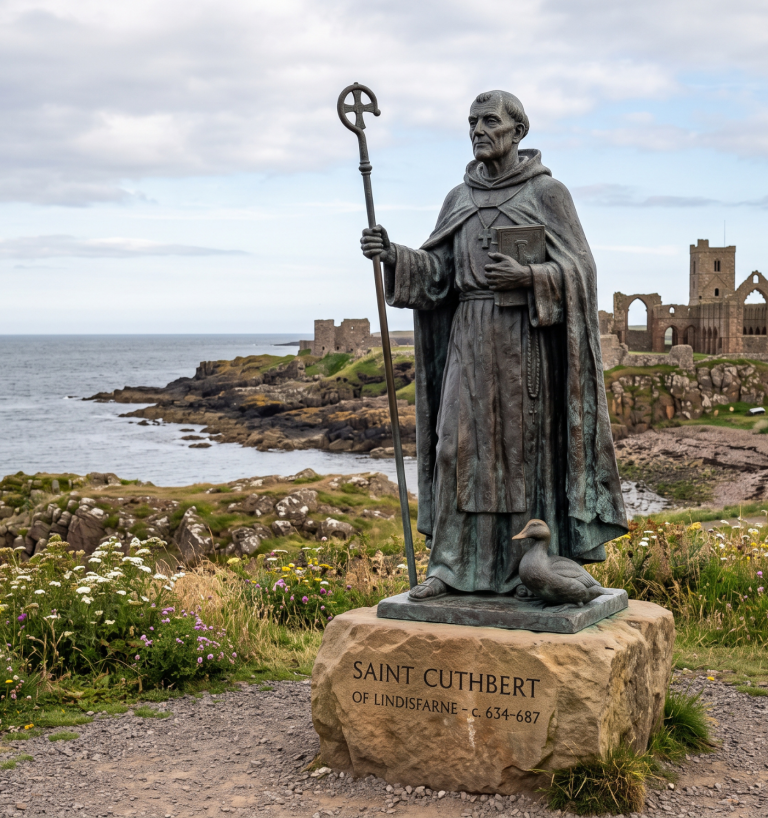

Saint Cuthbert of Lindisfarne: A Life of Prayer, Solitude, and Service
Saint Cuthbert (c. 634 – 20 March 687) stands as one of the most beloved and revered figures in the history of the early English Church. A monk, hermit, bishop, and miracle-worker, he lived at the heart of the Celtic Christian tradition, embodying its deep spirituality, love for creation, and commitment to the Gospel.
A Call in the Hills: The Vision of Aidan’s Soul
Cuthbert was born in Northumbria around the year 635 — the very year Saint Aidan founded the monastery on Lindisfarne. Though details of his early life are sparse, tradition holds that he came from a noble Anglo-Saxon family and spent his youth as a shepherd in the hills near Melrose.
It was during one of these quiet watches that a profound vision changed the course of his life. As he tended his flock under the night sky, he saw a luminous light rising from the east, carried by angels. The next morning, he learned that Saint Aidan, the beloved bishop of Lindisfarne, had passed away at that very hour. For Cuthbert, this was no mere coincidence — it was a divine summons. He interpreted the vision as a call to dedicate his life to God, and soon after, he entered the monastery at Melrose, then under the leadership of the wise prior Boisil, who became his spiritual mentor.
Saint Cuthbert – A Light in the North
Saint Cuthbert (c. 634 – 20 March 687) was a beloved monk, bishop, and hermit of the Celtic Christian tradition, closely associated with the monasteries of Melrose and Lindisfarne in northern England.
Known for his humility, wisdom, and compassion, Cuthbert lived a life of prayer and service. He was said to have a deep love for nature, often praying alone on the windswept shores of Holy Island, where the sea met the sky in silence. Stories tell of him caring for the sick, protecting the poor, and even sharing bread with the otters — earning him the affectionate nickname “Our Cuddy” among the people.
Cuthbert became Bishop of Lindisfarne in 685, guiding the community with gentleness and strength. Though he lived during a time of great change in the Church, he was a bridge between traditions — respected for his devotion, whether in solitude or in leadership.
After his death on 20 March 687, his tomb at Lindisfarne became a place of pilgrimage, and he was soon venerated as a saint. His relics were believed to work miracles, and he became known as the “Wonder-worker of England.”
Today, Saint Cuthbert is remembered as the patron saint of Northumbria — a shepherd of souls, a man of peace, and a quiet flame of faith that still burns in the hearts of those who seek God in stillness.
Saint Cuthbert of Lindisfarne: A Life of Prayer, Solitude, and Service
Saint Cuthbert (c. 634 – 20 March 687) stands as one of the most beloved and revered figures in the history of the early English Church. A monk, hermit, bishop, and miracle-worker, he lived at the heart of the Celtic Christian tradition, embodying its deep spirituality, love for creation, and commitment to the Gospel.
A Call in the Hills: The Vision of Aidan’s Soul
Cuthbert was born in Northumbria around the year 635 — the very year Saint Aidan founded the monastery on Lindisfarne. Though details of his early life are sparse, tradition holds that he came from a noble Anglo-Saxon family and spent his youth as a shepherd in the hills near Melrose.
It was during one of these quiet watches that a profound vision changed the course of his life. As he tended his flock under the night sky, he saw a luminous light rising from the east, carried by angels. The next morning, he learned that Saint Aidan, the beloved bishop of Lindisfarne, had passed away at that very hour. For Cuthbert, this was no mere coincidence — it was a divine summons. He interpreted the vision as a call to dedicate his life to God, and soon after, he entered the monastery at Melrose, then under the leadership of the wise prior Boisil, who became his spiritual mentor.
Monastic Life and Spiritual Formation
At Melrose, Cuthbert embraced the rigorous life of the Celtic monk — long hours of prayer, fasting, and manual labour. He was known for his humility, obedience, and deep contemplative spirit. Boisil, recognizing his gifts, entrusted him with increasing responsibility, and when Boisil fell ill, Cuthbert cared for him until his death, later succeeding him as prior.
Cuthbert’s time at Melrose shaped his character: gentle yet firm, prayerful yet active, deeply rooted in Scripture and the rhythms of the monastic day. He became known for his gift of spiritual counsel, drawing others to seek his wisdom.
From Hermit to Bishop: A Life of Balance
In 664, following the Synod of Whitby — a pivotal moment where the Northumbrian Church aligned more closely with Roman practices — Cuthbert moved to Lindisfarne, the holy island off the coast of Northumberland. There, he lived first as a hermit, seeking solitude in prayer and communion with God. The island, accessible only at low tide, became a sacred threshold between earth and heaven.
Yet Cuthbert was not called to remain in isolation. In 685, he was chosen as Bishop of Lindisfarne, a role he accepted with deep reluctance but faithful obedience. As bishop, he continued to live simply, travelling on foot to visit the scattered communities of Northumbria, preaching the Gospel with kindness and compassion. He was especially tender toward the poor, the sick, and the outcast.
Miracles and the Wonder-Worker of England
Even during his lifetime, Cuthbert was known for miracles — not as spectacles, but as signs of God’s love. He healed the sick, calmed storms, and was said to have a special bond with nature. One famous story tells of him protecting a family of otters who came to warm themselves by his fire after he had spent a night in prayer, drenched by the sea.
After his death on 20 March 687, his tomb at Lindisfarne became a place of pilgrimage. When his body was exhumed eleven years later, it was found to be incorrupt — a sign, to the faithful, of his holiness. This miracle, along with many others attributed to his intercession, earned him the title “Wonder-worker of England.”
A Bridge Between Worlds
Cuthbert lived during a time of great transition. He was formed in the Celtic tradition — with its love for nature, mysticism, and monastic independence — yet he embraced the unity of the wider Church after Whitby. In this, he became a bridge: a man of deep prayer who also served with humility, a hermit who became a shepherd, a monk who walked with kings and commoners alike.
Legacy and Veneration
Saint Cuthbert is remembered as the patron saint of Northumbria. His relics were carried in procession for centuries, especially during times of war or plague, and his shrine at Durham Cathedral became one of the most important pilgrimage sites in medieval England.
Even today, his spirit lingers — in the tides that wash the shores of Lindisfarne, in the quiet prayers of those who seek God in stillness, and in the hearts of all who value gentleness, faithfulness, and love.
He remains, as he was in life, a light in the north — not blazing, but steady, guiding us home.

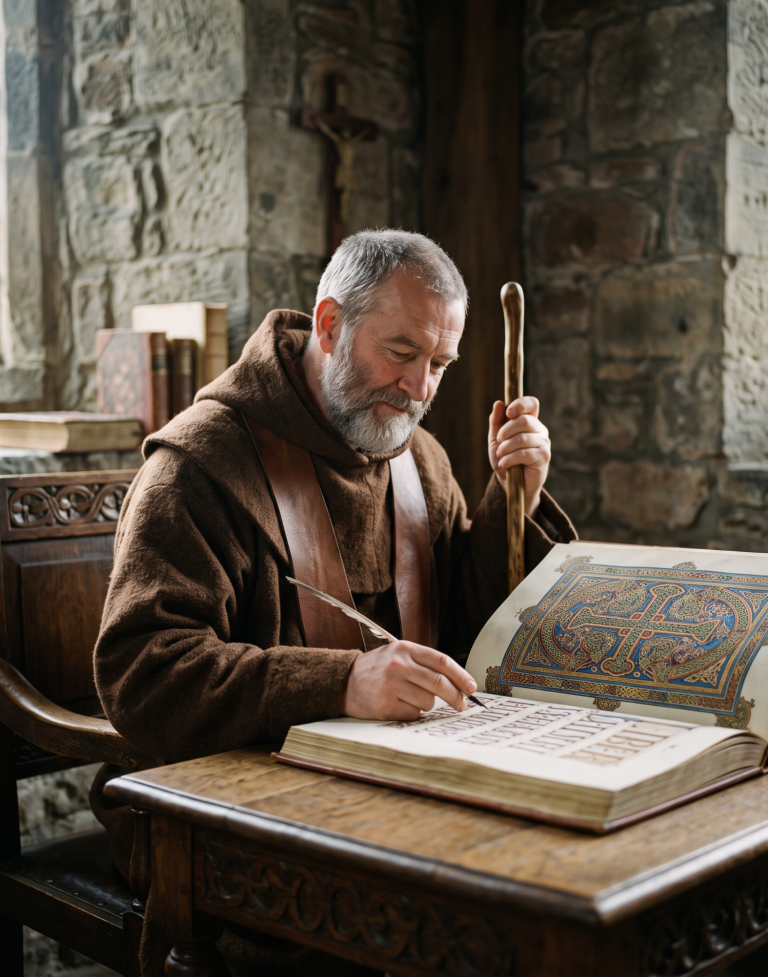
Saint Cuthbert at prayer
Known as the Fire of the North see book of same title by Revd David Adam. Saint Cuthbert is known for several prayers, including an all night prayer vigil up to his neck in the North Sea and by morning two sea otters licked his feet dry.
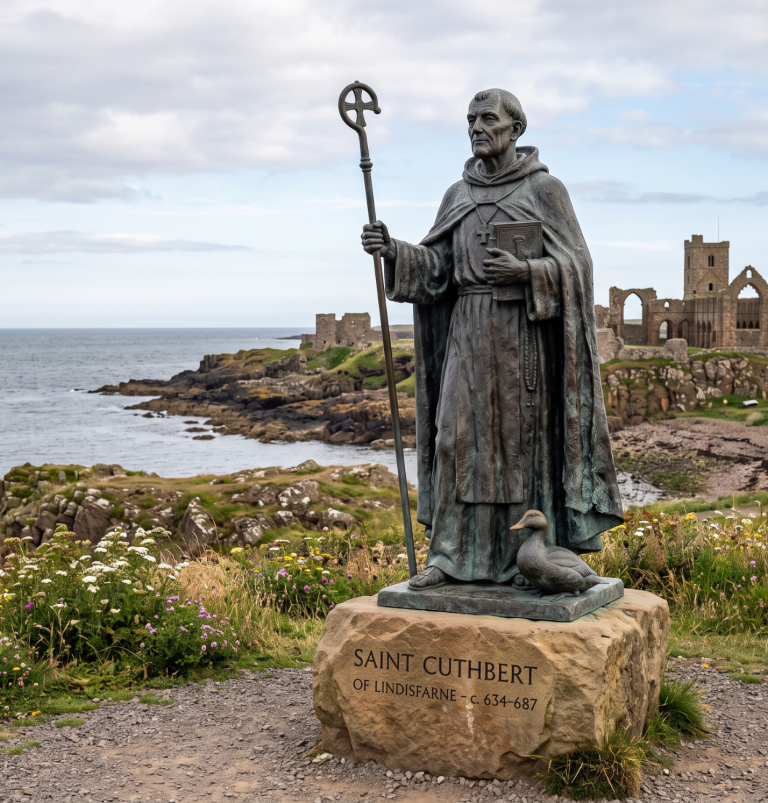
Saint Cuthbert at Prayer
Saint Cuthbert of Lindisfarne: A Life of Prayer, Solitude, and Service Saint Cuthbert (c. 634 – 20 March 687) stands as one of the most beloved and revered figures in the history of the early English Church. A monk, hermit, bishop, and miracle-worker, he lived at the heart of the Celtic Christian tradition, embodying its deep spirituality, love for creation, and commitment to the Gospel.
Again at Prayer Stillness
"For Stillness and Presence" – A Prayer in the Spirit of Saint Cuthbert Let your heart return to God, as the tide returns to the shore. In silence, He speaks. In stillness, He guides. May this moment of peace draw you into His presence. For all who seek quiet, clarity, and closeness.
For those who Serve
For Those Who Serve" – A Prayer in the Spirit of Saint Cuthbert To all who walk in hidden paths, pray in silence, and love in secret — may your quiet faithfulness be blessed. Like Cuthbert, may your life be a living prayer. In service, there is holiness.